I wasn’t there for the buildings.
My second granddaughter was born at Hoag Hospital Irvine on May 6. I drove up the next morning to meet her, and the R5 came along for her, not for architecture. But a hospital visit has its share of in-between time: walking in from the parking lot, waiting for the right moment to go up, stepping outside for some air. And I can’t walk past good shapes without noticing them. So I made four photographs in two short windows, one a little after eight and another just after ten. All four were at 24mm with the lens wide open, the way you shoot when you aren’t really there to shoot.
I’m glad I did. Looking at them together now, they feel like one small set. They don’t feel like four separate pictures.
What ties them together first is the light and the palette. It was a clean, bright Southern California morning, and nearly everything in the frames is pale: white panels, cream travertine, silver metal, pale concrete, sky. Against that, three warm notes keep coming back. There’s the honey-brown wood cladding, the trunks of the palms, and a thick yellow line of tactile paving along the curb. Those small accents do a lot of work. Without them, the set would feel sterile, which is the last word you want attached to the place where you meet a new member of your family.
The second thread is line. Every one of these photos is about lines leading somewhere. In the widest frame, the curb curves out of the lower left and pulls you toward the entrance. The long canopies slant in from the right, and their diagonals meet near the older white hospital tower in the middle. The palms on the left stand like a row of exclamation points, and they keep the eye from drifting out of the frame. I kept that one in a 2:1 crop because the drive and the canopies wanted the width.
Under the canopy, the lines take over completely. The skylights overhead and the yellow strip on the ground both run deep into the frame. A single wayfinding sign stands in the middle of the drive in its own small pool of shadow, and it ends up as the subject almost by accident. Its arrows point one way for through traffic and the other way for patient pickup. Somewhere upstairs, a new family was getting ready to use the pickup lane for the first time.
The tower is the odd one out, and it was the first frame I made. I tipped the camera up at the bands of blue glass and let the building lean away from me instead of correcting it. Ten stacked rows of windows read like lines on a page, and the clean edge of the building cuts a hard diagonal across the sky. A young tree in the lower right corner softens all that geometry. It’s the only thing in the set that’s still growing, which fits.
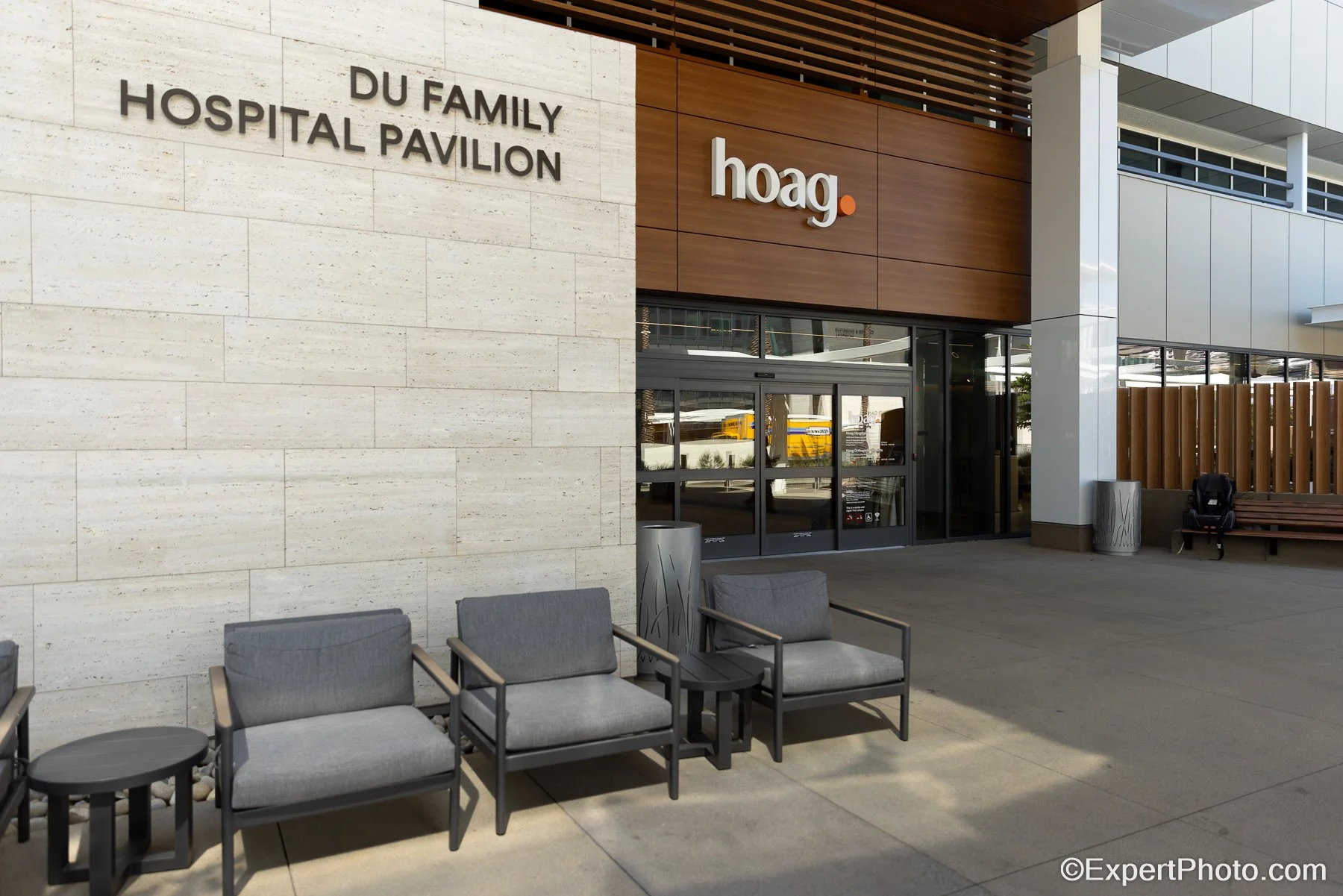
Then there’s the entrance. The Du Family Hospital Pavilion is the new front door to Hoag’s Sun Family Campus. Inside the glass you can read the reflection of a bright yellow truck, a reminder that the place was still being finished around us. Three gray chairs sit empty in front of the travertine. Off to the right, on a wooden bench, someone had left an infant car seat. I didn’t notice it until I was editing. Of everything in the four frames, it’s the detail that tells you what kind of place this is.
Hospitals spend a lot on looking calm, and in these photographs it works. There are almost no people in them, just the space doing its quiet work of welcoming whoever comes through next. She had come through the day before. That morning, it was my turn to arrive.